Veletri (epoprostenol) for pulmonary arterial hypertension
 Fact-checked by
 What is Veletri for pulmonary arterial hypertension?
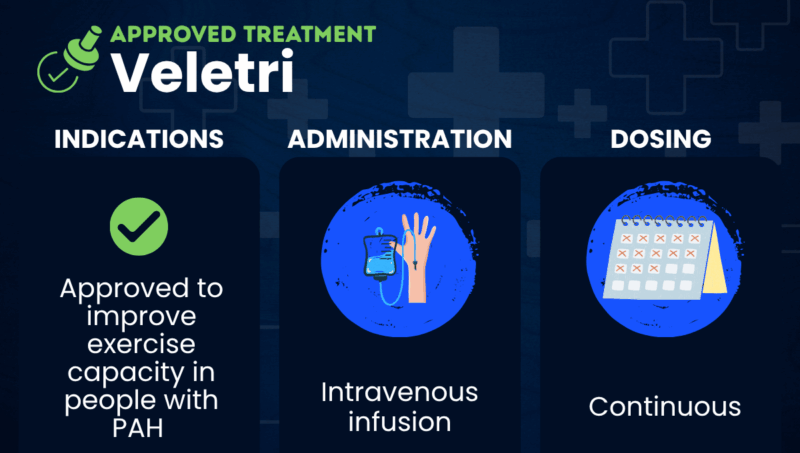
Veletri (epoprostenol) is an intravenous (into-the-vein) infusion therapy approved to improve exercise capacity in people with pulmonary arterial hypertension (PAH).
PAH is a type of pulmonary hypertension — high blood pressure in the arteries that carry blood from the heart to the lungs — that’s caused by the narrowing of pulmonary arteries. This compromises blood flow through the lungs, limiting the transfer of oxygen into the bloodstream and making physical activity more difficult.
Veletri contains epoprostenol, a lab-made version of prostacyclin, a naturally occurring molecule that causes blood vessels to widen. By mimicking prostacyclin, Veletri helps open up the pulmonary arteries and relieve pressure in the lungs, thereby easing symptoms of PAH.
The therapy contains a reformulated version of epoprostenol that is stable at room temperature, making it easier to store and administer than earlier formulations, which required continuous refrigeration for storage and infusion. This reformulation could offer greater convenience for patients and caregivers.
The brand-name medication was developed by Actelion Pharmaceuticals, now part of Johnson & Johnson. The company markets an equivalent product under the brand name Caripul in Canada. Generic versions of epoprostenol sodium are available in the U.S., but not all of them are directly interchangeable with Veletri.
Therapy snapshot
| Brand name | Veletri |
| Chemical name | Epoprostenol |
| Usage | Used to improve exercise capacity in people with PAH |
| Administration | Intravenous infusion |
Who can take Veletri?
Veletri is approved in the U.S. to improve exercise capacity in people with PAH (World Health Organization Group 1). Its safety and effectiveness in children are not established.
Veletri is contraindicated, or should not be used, in patients:
- with congestive heart failure due to severe left ventricular systolic dysfunction, in which the main pumping chamber of the heart, the left ventricle, is too weak to pump blood properly
- who experience pulmonary edema, or fluid buildup in the lungs, during dose initiation
- with a history of hypersensitivity (severe allergic reaction) to epoprostenol or to structurally similar compounds.
In Europe and other countries, Veletri is indicated for patients with idiopathic or familial PAH and PAH associated with connective tissue diseases who have marked or severe limitations in physical activity (WHO functional class III or IV).
How is Veletri administered?
Veletri is given as a continuous intravenous infusion through a small tube, or catheter, that’s surgically inserted into a large vein near the heart. The infusion is controlled with an external battery-operated pump. Treatment is typically long-term and requires careful monitoring.
The specific dose of Veletri is individualized for each patient and adjusted gradually based on clinical response and side effects.
- The infusion is started in a healthcare setting, where the dose will be gradually increased under close monitoring. The starting rate is 2 nanograms per kilogram of body weight each minute.
- Once a stable maintenance dose is achieved, patients and caregivers can manage the infusion at home with proper training on Veletri storage, preparation, and administration.
Patients should alert their clinical team if PAH symptoms or medication side effects worsen, as the dose may need adjustment. Except in life-threatening situations, dosing initiation and changes should be made only under the direction of a physician. Lowering the dose too quickly or abruptly stopping Veletri may not be safe.
Veletri comes as a room-temperature-stable powder that is dissolved in a sterile liquid before infusion. Once mixed, the prepared solution can be used immediately or stored in the refrigerator for up to eight days.
Veletri in clinical trials
The U.S. approval of Veletri for PAH was supported by clinical trials that predominantly involved people with severe PAH (New York Heart Association functional class III or IV). The trials generally showed that patients who received Veletri in addition to standard treatment exhibited significant improvements in their ability to exercise, as measured by the six-minute walk test, compared with those on standard therapy alone.
- The first two trials involved people with idiopathic or heritable PAH. In the larger study, patients were able to walk a median of 31 meters farther in six minutes after three months on Veletri, compared with a decrease in exercise ability seen with conventional treatment alone. Veletri was also associated with improvements in blood flow and a survival benefit in these studies.
- Another trial involved people with PAH associated with scleroderma, a connective tissue disease. The study also showed that Veletri, when combined with standard treatment, led to improvements in exercise ability and measures of blood flow compared to standard therapy alone.
Long-term studies further showed that Veletri led to sustained benefits with chronic dosing and was associated with improved survival compared with natural history data from untreated PAH patients.
Veletri side effects
The most common side effects during Veletri initiation and dose escalation include:
- nausea
- vomiting
- headache
- low blood pressure
- flushing
- chest pain
- anxiety
- dizziness
- slow or fast heartbeat
- shortness of breath
- abdominal pain
- musculoskeletal pain.
With chronic dosing, the most common side effects are:
- headache
- jaw pain
- flushing
- diarrhea
- nausea and vomiting
- flu-like symptoms
- anxiety or nervousness.
Patients should not abruptly lower the dose or stop using Veletri, as this can cause a severe rebound of PAH symptoms. A healthcare provider should monitor all changes in dosing.
Some medications may interact with Veletri. Patients should tell their doctors about all medications they are using.
Pulmonary Hypertension News is strictly a news and information website about the disease. It does not provide medical advice, diagnosis, or treatment. This content is not intended to be a substitute for professional medical advice, diagnosis, or treatment. Always seek the advice of your physician or other qualified health provider with any questions you may have regarding a medical condition. Never disregard professional medical advice or delay in seeking it because of something you have read on this website.