Pulmonary hypertension complications
 Reviewed by
 Pulmonary hypertension (PH) is a rare but severe health condition characterized by high blood pressure in the blood vessels that transport blood from the heart to the lungs.
In PH, the pulmonary arteries become narrowed and stiff, making it more difficult for blood to pass through them. As a result, the right side of the heart, or right ventricle, has to work harder to pump blood through the arteries, which can cause it to become enlarged and weakened. In severe cases, PH can lead to heart failure.
There are several forms of PH, with different causes, treatments, and outcomes. Treatment depends on the type of PH, but generally aims to help manage symptoms, address the underlying cause, and reduce the risk of complications.
How PH causes complications
PAH is progressive, meaning it gets worse over time. This means that, without treatment or after a long period of living with the condition, it adversely affects the heart and leads to complications.
It does so through the following processes:
- High resistance in the blood vessels: High resistance in the lungs’ blood vessels forces the right ventricle to pump much harder than usual to circulate blood. Symptoms at this stage may only be subtle, such as mild breathlessness.
- Thickening of the heart muscle: The heart muscle increases in size in response to the greater workload, in an attempt to maintain normal blood flow. People may notice increased breathlessness during everyday activities.
- Constant high pressure: The resulting constant high pressure causes the thickened heart muscle to tire and become unable to keep up with the increased demand. The right ventricle begins to stretch and widen so as to hold more blood and maintain normal output, but this reduces its pumping efficiency. At this point, stamina and breathlessness may worsen.
- Decompensation: Decompensation, in which blood backs up into the blood vessels instead of moving into the lungs, then occurs. This marks the transition to right heart failure and body-wide fluid retention. It can lead to swelling in the ankles, legs, and abdomen, and/or sudden, unexplained weight gain due to fluid buildup. Dizziness, light-headedness, and fainting from reduced oxygenated blood circulation can also occur.
Common PH complications
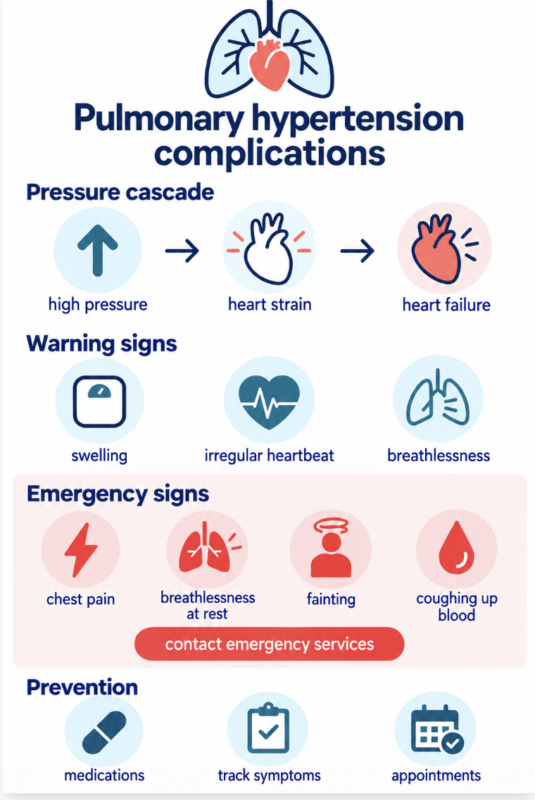
Several types of PH complications can occur after the condition increases pressure on the right side of the heart. Major complications are right-sided heart failure, called cor pulmonale, arrhythmias, blood clots in the lungs, and coughing up blood.
Knowing the warning signs and being able to spot them can help people with PH and their caregivers to recognize and seek immediate medical attention. Identifying PH complications early and getting treatment quickly can help prevent severe damage from occurring.
Cor pulmonale
Cor pulmonale, or right-sided heart failure, is a significant complication of PH. In the U.S., cor pulmonale accounts for 6% to 7% of heart disease cases, with PH being one of the causes.
It results from the heart’s effort to pump blood through the narrowed pulmonary arteries. The body’s initial response to stress is to compensate with thickened walls and an enlarged ventricle, but at some point, the right ventricle collapses from overwork. This complication can also occur due to blood clots on the lungs.
Warning signs may include:
- extreme tiredness and sleepiness
- fainting during physical activity
- swelling of the abdomen and lower legs
However, these symptoms may only be noticeable long after cor pulmonale has developed.
Arrhythmias
In PH, arrhythmias, or irregular heartbeats, may develop due to a disruption of the heart’s conduction system. As the right side of the heart starts to enlarge and work harder in response to increased pressure, it can cause scarring, or fibrosis, on the right side of the heart.
Electrical signals usually keep the heart’s rhythm regular, but this structural damage can interfere with the way that electrical signals move through the heart. Low oxygen levels can also interfere with heart rhythm.
Symptoms of arrhythmias might include:
- a feeling of fluttering, pounding, or racing in the chest
- an unusually fast or slow heartbeat
- chest pain
- breathlessness
- anxiety
- fatigue
- dizziness or light-headedness
- fainting
Chest pain, breathlessness, and fainting due to arrhythmia are signs that a person with PH needs emergency care. Patients or their caregivers should call 911 if these occur.
Blood clots
Blood clots are another possible complication of PH.
When such clots occur in the lungs, they are known as pulmonary embolisms. In people with PH, they can develop in the small arteries in the lungs. While blood clots can narrow the arteries even further, most are reversible with medication.
A rare type of PH called chronic thromboembolic pulmonary hypertension (CTEPH) can also result from a history of pulmonary embolisms. However, blood clots can occur due to any type of PH.
Symptoms of pulmonary embolisms include:
- sudden breathlessness, even while resting, which worsens with physical activity
- chest pain, which may feel like a heart attack, often with sharp pain that becomes clearer during deep breaths, coughing, or leaning over, or prevents the ability to take deep breaths
- fainting
- irregular heartbeat
- coughing that may produce mucus that contains blood
- dizziness or light-headedness
- fever
- leg pain, swelling, or both, often in the back of the calves
- clammy skin that has changed color, known as cyanosis
Hemoptysis, or coughing up blood
Hemoptysis can happen in PH and is a dangerous complication that occurs when high blood pressure damages the lungs’ fragile blood vessels. The increased pressure can cause blood vessels to burst and bleed into the airways.
The body tries to adapt by growing extra blood vessels to bypass the broken ones, but the ongoing high pressure also easily stretches, weakens, and tears these new, thin-walled vessels.
Hemoptysis can also result from enlarged pulmonary arteries, blood clots, or underlying conditions in which the blood does not clot as it should.
Warning signs include:
- coughing up blood, either in the form of blood-streaked mucus or large amounts of blood
- breathlessness
- a dry cough
- severe fatigue
- weakness
- swelling
- chest pain
- wheezing
- a raspy voice
Even small streaks of blood in mucus can be a sign of early hemoptysis. Individuals with PH should contact emergency services at the first sign that they are coughing up blood.
Preventing PH complications
PH is a life-threatening condition, but there are ways of preventing complications or delaying onset and progression.
Sticking to a medication schedule
Medications for PAH aim to improve vascular health in the lungs, relieve symptoms, and prevent the condition from worsening.
The medications prescribed for PH will vary depending on the type of and the underlying cause. Typically, medications for PH can be taken by mouth or via a central venous catheter.
Options may include:
- calcium channel blockers, for those with positive vasoreactivity testing
- endothelin receptor antagonists, such as ambrisentan, bosentan, and macitentan
- PDE-5 inhibitors, including sildenafil, tadalafil, and vardenafil
- soluble guanylate cyclase stimulators, such as riociguat
- prostacyclin analogs, including epoprostenol, treprostinil, and iloprost
- prostacyclin receptor agonists, such as selexipag
- diuretics, if a person shows signs of fluid retention and right ventricular failure
- anticoagulants, a lifelong therapy taken by people with CTEPH
- oxygen therapy to supplement oxygen levels
Lifestyle modifications
For people with PH, lifestyle management can help to keep the lungs and heart as healthy as possible.
Steps may include the following:
- maintaining a low-salt diet
- taking part in a supervised exercise training program, though avoiding excessive physical activity that can tax the heart and lungs
- getting routine vaccinations against influenza, SARS-CoV-2, and Streptococcus pneumoniae, a bacteria that causes pneumonia, as such infections can make complications more likely
- avoiding triggers, such as high altitudes and certain medications, to prevent symptom exacerbation
Treating co-occurring conditions
A review from 2019 showed that about three-quarters of those with PH have at least one other condition, which can lead to negative outcomes. PH patients with additional health problems should talk with their healthcare team about ways to treat all conditions, with a goal toward an improved outlook and better long-term survival.
Surgery
In some cases, people with PH need lung transplants or heart-lung transplants to survive. This approach is usually the last resort, however, due to the risks of the procedure.
Among people with CTEPH, surgery may be necessary to clear pulmonary emboli and widen blood vessels.
Daily symptom and risk monitoring
It is important for people with PH to maintain and attend regular follow-up appointments with their healthcare team.
To prevent complications, patients should self-monitor for the following symptoms and touch base with their PH care team if any occur:
- signs of right-sided heart failure, such as weight gain and swelling of the stomach and lower limbs
- breathing changes, including shortness of breath during physical activity
- systemic signs, such as fatigue, exhaustion early into physical activity, tiredness, loss of appetite, dizziness, and fainting
- heart symptoms, such as palpitations and chest pain
It’s important for patients to contact emergency services if they experience any of the following:
- a heart rate that will not go down
- frequent fainting or passing out
- problems with a catheter that delivers medications – for example, it keeps moving out of position, the solution keeps leaking out, or the pumping is not working as it should
- feeling breathless, even after resting
- any sudden severe chest pain
- a sudden headache
- feeling weakness in the arms or legs or an inability to move them
Pulmonary Hypertension News is strictly a news and information website about the disease. It does not provide medical advice, diagnosis, or treatment. This content is not intended to be a substitute for professional medical advice, diagnosis, or treatment. Always seek the advice of your physician or other qualified health provider with any questions you may have regarding a medical condition. Never disregard professional medical advice or delay in seeking it because of something you have read on this website.