
 Discussion
Pulmonary hypertension treatment
Last updated Oct. 28, 2025, by Lindsey Shapiro, PhD
 Fact-checked by José Lopes, PhD
There is no cure for pulmonary hypertension (PH), but appropriate treatment can slow disease progression, ease symptoms, and improve life quality.
In PH, pressure is elevated in the pulmonary arteries, which carry blood from the heart to the lungs. This compromises oxygen delivery to the rest of the body and strains the heart.
Various factors must be considered when selecting an appropriate PH therapy for each case. A person’s care needs may also change over time as PH progresses, so treatment selection is an evolving process.
Approved PH treatment options
The various underlying PH causes form the basis for the World Health Organization’s classification system. Currently, the only PH medications available are specifically approved for pulmonary arterial hypertension (PAH), chronic thromboembolic PH (CTEPH), and PH associated with interstitial lung disease (PH-ILD).
Other types of the disease are treated with supportive care to ease PH symptoms and prevent complications. For any form of PH, managing the underlying condition that may be causing the disease is also key.
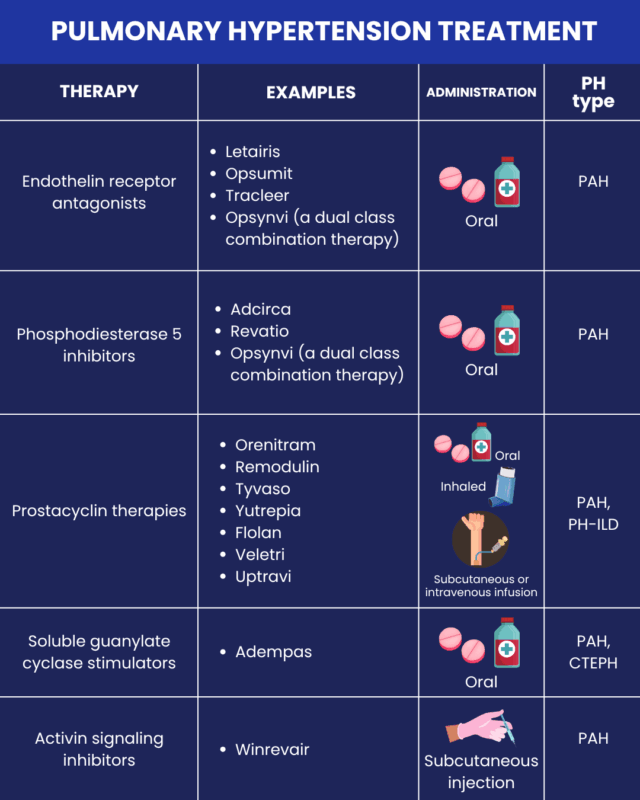
Winrevair (sotatercept-csrk) is an injectable PAH treatment designed to prevent the abnormal cell growth contributing to blood vessel narrowing in the disorder. Other approved PH medications work as vasodilators for PH, helping to relax blood vessels to improve blood flow and help the heart pump more easily. This includes:
- Endothelin receptor antagonists (ERAs): A class of oral PAH therapies that includes Letairis (ambrisentan), Opsumit (macitentan), and Tracleer (bosentan).
- Phosphodiesterase 5 inhibitors (PDE5i): A class of oral PAH therapies that includes Adcirca (tadalafil) and Revatio (sildenafil).
- Opsynvi (macitentan and tadalafil): A fixed-dose oral combination of tadalafil, a PDE5i, and macitentan, an ERA, that’s cleared in the U.S. for certain adults with PAH.
- Prostacyclin therapy: A group of PAH therapies including formulations of treprostinil (Orenitram, Remodulin, Tyvaso, Yutrepia), epoprostenol (Flolan, Veletri), and selexipag (Uptravi). They may be taken orally, infused into the bloodstream (intravenous), infused under the skin (subcutaneous), or inhaled into the lungs. Tyvaso and Yutrepia are also approved for PH-ILD.
- Adempas (riociguat): An oral soluble guanylate cyclase stimulator that is approved in the U.S. for PAH and CTEPH.
The treatment of PH may also involve other interventions to improve blood flow and heart health, including:
- calcium channel blockers, to relax blood vessels
- blood thinners, or anticoagulants, to prevent clots
- diuretics, to reduce fluid buildup and ease heart strain
- oxygen therapy, to improve oxygen delivery
Surgery
In cases where medications don’t adequately control PH, a doctor may recommend surgery to reduce pressure in the right side of the heart, called atrial septostomy. Rarely, a heart or lung transplant for PH may be recommended.
For many people with CTEPH, a surgery called pulmonary thromboendarterectomy is the first-line treatment. It involves removing blood clots from the lungs and may be curative in some cases. A non-surgical procedure called balloon pulmonary angioplasty, which involves widening blocked pulmonary arteries by inflating small balloons, may be recommended for patients deemed unsuitable for surgery.
Experimental and alternative PH treatments
Numerous experimental therapies and devices are being tested in preclinical and clinical studies for the treatment of various PH types. Some belong to the existing major treatment classes, while others work via novel mechanisms.
A few classes of experimental therapies being developed for PH include:
- Kinase and growth factor modulators, which aim to inhibit the abnormal cellular changes that cause blood vessel narrowing in PAH. Includes seralutinib, in Phase 3 testing.
- Medications designed to enhance the therapeutic profile of existing medication classes. Includes ralinepag, a prostacyclin therapy in Phase 3 testing.
When or if such investigational therapies will be approved is not known.
Treatment considerations
Finding the right treatment strategy that works best for each person can take some time. Various factors can influence treatment choices, including:
- specific symptoms
- disease classification
- disease severity and risk of progression.
After a PH diagnosis, patients must work closely with their healthcare team to find the right PH management strategy for their individual case. Existing PH treatment guidelines can help patients and their physicians decide appropriate treatments.
Pulmonary Hypertension News is strictly a news and information website about the disease. It does not provide medical advice, diagnosis, or treatment. This content is not intended to be a substitute for professional medical advice, diagnosis, or treatment. Always seek the advice of your physician or other qualified health provider with any questions you may have regarding a medical condition. Never disregard professional medical advice or delay in seeking it because of something you have read on this website.
Related articles
-
Discussion
-
 Discussion
-
 Discussion
-
 Discussion
-
 Discussion
-
 Discussion