
How the grief of living with a rare illness has influenced my art
My artwork tells a story, intentional or not
Written by |

After a difficult winter and spring dealing with several health setbacks, I’m slowly dipping my toes back into my day-to-day interests. This includes things like knitting, cooking, and reading, but mostly, it means digging back into my art practice.
As I ride this recent wave of creative rejuvenation, I can’t help but step back and examine my intentions. When I started seriously exploring art in 2018, I felt free to try anything. I mixed illustration and poetry to create pieces that had very clear emotional messaging.
However, as my art practice has progressed, I’ve started exploring watercolor and oil painting. As a result, the categories have naturally begun to separate. In recent years, I’ve felt that writing and painting have served very different purposes. I’ve used writing to talk about my health and tell my story, while my painting has existed as an outlet for beauty and enjoyment.

Coming back to my studio last week after months of disuse, I took some time to reflect on my existing body of work. In doing this, I realized that my art does tell a story, whether or not it’s been intentional.
A common theme in my painting is windows. Whether I’m depicting a landscape or a still life, there’s often a window or two mixed into the narrative. This is largely because we paint what we see. Because I’m immunosuppressed, so much of my time post-heart and lung transplant has been spent at home. At any given moment, I am looking outward, attempting to glimpse a world that is just a bit out of reach.
This message, while very literal, also holds a metaphorical weight that seems to stretch across my entire life spent battling a rare disease. Living with pulmonary hypertension, a part of me always felt outside of things. My illness presented a barrier to the life my peers seemed to be experiencing. At the same time, despite their good intentions, I don’t think my peers ever truly knew what I was experiencing.
Silver linings
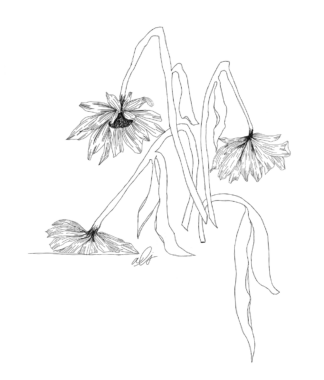
“Wonders Never Cease”: Anna Jeter’s artwork submission reflects the grief she was experiencing in 2019. (Courtesy of Anna Jeter)
Pushing further back, I recall an art prompt from a local gallery: “Wonders Never Cease.” The submissions were stunning. One piece was a colorful embroidered tapestry; another was a mesmerizing linocut of detailed, hand-worked waves, leaving negative space to spell out the prompt. Then there was my submission. Freshly discharged from the hospital following my transplant, I had shakily sketched out a simple wilting bouquet of sunflowers.
For a long time afterward, I laughed about that submission — my tiny black-and-white illustration of dying flowers, an almost comical response to such a hopeful prompt. The drawing was accompanied by my short artist’s statement, the perfect summary of what I was going through at the time: “Even in this grief, wonders never cease.”
Looking back now, I’m quite fond of that response. Since then, more than once, I’ve depicted flowers in decay, a nod to my lifetime of terminal illness and the grief that this knowledge has imposed on my life. These details are important parts of who I am as a person. It’s no surprise they’ve snuck into my art.
Despite the heavy concepts my works may allude to, I always hope to counteract them with beauty, color, and light. In the mundane and difficult repetition of my day-to-day life, I’ve always been able to find silver linings, and I hope those are just as evident in every piece of artwork I create.
Note: Pulmonary Hypertension News is strictly a news and information website about the disease. It does not provide medical advice, diagnosis, or treatment. This content is not intended to be a substitute for professional medical advice, diagnosis, or treatment. Always seek the advice of your physician or other qualified health provider with any questions you may have regarding a medical condition. Never disregard professional medical advice or delay in seeking it because of something you have read on this website. The opinions expressed in this column are not those of Pulmonary Hypertension News or its parent company, Bionews, and are intended to spark discussion about issues pertaining to pulmonary hypertension.



Leave a comment
Fill in the required fields to post. Your email address will not be published.