Pulmonary hypertension overview
Last updated Oct. 29, 2025, by Lindsey Shapiro, PhD
 Fact-checked by Jose Lopes, PhD
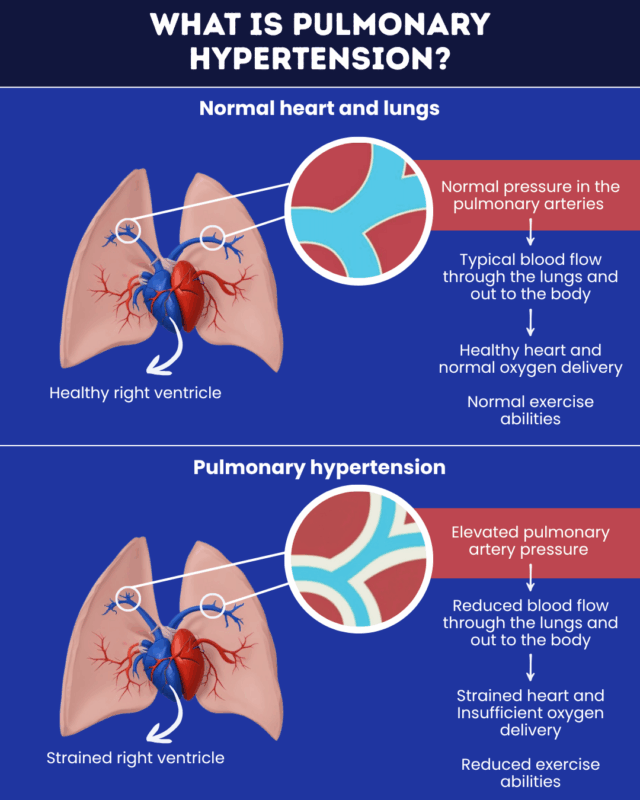
Pulmonary hypertension (PH) is a group of progressive diseases characterized by elevated pressure in the blood vessels, called the pulmonary arteries, that supply blood from the heart to the lungs.
For people with these conditions, the heart has to work harder to pump blood through the lungs. This compromises oxygen delivery to the body and leads to heart strain or right heart failure.
In most cases, there is no cure for the rare disease, and the PH prognosis varies widely depending on several factors. For all patients, reaching a prompt diagnosis and starting treatment as soon as possible can help ease symptoms, prevent complications, and improve life quality.
Causes and risk factors
There are numerous possible causes of PH, including:
- heart disease
- lung conditions
- chronic exposure to low oxygen levels
- blood clots
- HIV/AIDS
- certain medications
- some inherited genetic mutations
Other health conditions, such as blood disorders, inflammatory diseases, metabolic conditions, connective tissue diseases, liver or kidney disease, and tumors, can also cause PH.
All of these are thus considered PH risk factors. Cardiovascular factors, such as being overweight and smoking, may also increase the risk of PH.
Identifying the cause of PH is essential because it helps physicians classify it and determine the best treatment approach.
Types of pulmonary hypertension
The World Health Organization (WHO) classifies PH in five groups based on the underlying cause:
- Group 1: In pulmonary arterial hypertension (PAH), the pulmonary arteries are narrowed due to one of several possible reasons, including medications, other medical issues, genetic factors (heritable PAH), or an unknown cause (idiopathic PAH).
- Group 2: PH is caused by left-sided heart disease, such as left-sided heart failure or valve disease.
- Group 3: PH is caused by lung diseases or conditions that cause low oxygen levels, such as sleep apnea or chronic exposure to high altitudes.
- Group 4: In chronic thromboembolic pulmonary hypertension (CTEPH), PH is caused by chronic blood clots in the lungs.
- Group 5: PH arises secondarily to other health conditions, including certain blood disorders, inflammatory conditions, kidney disease, metabolic abnormalities, or tumors.
Common symptoms
PH does not always cause symptoms initially, but as a progressive disease, its manifestations usually get worse over time. Some common symptoms of PH are:
- shortness of breath
- fatigue and weakness
- chest pain or pressure
- heart palpitations or racing
- dizziness or fainting
- swelling in the ankles, legs, or abdomen
The first obvious PH symptom is often shortness of breath, though it may initially be noticeable only with exercise.
Other possible symptoms include a blue coloration of skin and lips, cough, wheezing, vocal hoarseness, and gastrointestinal and appetite issues.
The earliest PH symptoms can be mild and nonspecific — overlapping with many other conditions — so it’s important to see a doctor promptly when they arise.
Diagnosis
Reaching a diagnosis of PH starts with a physical exam and the taking of a medical history to look for symptoms and risk factors. Then, a doctor may run various other tests to look at heart and lung health. Among them may be:
- right heart catheterization, to directly measure pulmonary artery pressure
- an echocardiogram, to visualize the heart and how blood flows through it
- an electrocardiogram, to record the heart’s electrical activity
- chest imaging, including cardiac MRI, chest X-ray, or CT scan, to get detailed pictures of the heart and lungs
- pulmonary function tests, to see how well the lungs are working
- exercise tests, which assess a person’s exercise capacity
Other tests may also be done to determine the underlying PH cause. It’s important for PH to be diagnosed as early as possible, because this will allow the start of PH treatments that can help slow disease progression and ease symptoms.
Treatment and management
There are various PH treatment options, which may be injected, inhaled, or taken orally. Typically, these are intended to help improve blood flow and make exercise easier. A specialized, multidisciplinary care team will help choose the best regimen based on disease classification, symptom severity, and risk of progression.
Approved PH medications include:
- endothelin receptor antagonists (ERA), including Letairis (ambrisentan), Opsumit (macitentan), and Tracleer (bosentan)
- phosphodiesterase-5 inhibitors (PDE5i), which may be Adcirca (tadalafil) and Revatio (sildenafil)
- prostacyclin therapies, including formulations of treprostinil (Orenitram, Remodulin, Tyvaso, Yutrepia), epoprostenol (Flolan, Veletri), and Uptravi (selexipag)
- Opsynvi (macitentan and tadalafil), a fixed-dose combination of a PDE5i and an ERA
- Adempas (riociguat), a soluble guanylate cyclase stimulator
- Winrevair (sotatercept-csrk), an activin signaling inhibitor
Most of these are solely approved for PAH, although Tyvaso and Yutrepia are also approved for people with PH associated with interstitial lung disease, and Adempas is cleared for CTEPH. Not all of these medications are approved for managing PH in children.
Oxygen therapy for PH, as well as medications to manage PH and heart disease, are also widely used as supportive care measures. Surgery to remove the PH-causing blood clots is often a first-line approach for CTEPH.
Living with pulmonary hypertension
Living with PH can take a physical and emotional toll.
Moving around may become more difficult as the disease progresses, requiring changes to one’s daily routine. A person’s healthcare team can give advice about PH and lifestyle management in each individual case, including exercise considerations with PH, and choices about diet, pregnancy, or travel.
Therapy, counseling, or patient support groups may help patients cope with the emotional impact of PH. Many organizations also offer PH support resources for patients and caregivers, including:
Pulmonary Hypertension News offers the latest news and updates, patient columns, and community forums to support those navigating life with PH.