
Why writing letters is important for both sender and recipient
We could all benefit from this form of connection
Written by |

There is a quiet epidemic of loneliness happening in the world. We have replaced effort with ease and lost the health benefits of real human connection. We text instead of talking and share our lives on social media. Emoji hearts, hugs, and thumbs up or down are empty calories that sustain our souls for about as long as it takes to scroll to the next electronic interaction.
Writing letters and sending cards through snail mail are old remedies that can help both the sender and the recipient battle loneliness. It sends the message that you care before the correspondence is even opened.
Do you know an older adult who doesn’t use email or social media? They may only receive bills and junk mail, which get tossed onto a table with dread or indifference.
National Letter to an Elder Day is celebrated every year on Feb. 26. It’s the perfect time to go old school and help yourself and someone else feel less lonely.

What does writing a letter have to do with PH?
Treating the whole person is something we advocate for in the pulmonary hypertension (PH) community. How we feel emotionally is as important as how we feel physically. They are connected, and one can greatly affect the other.
A handwritten letter, whether short or long, can be applied to the spoon theory. Imagine you have a handful of spoons, each representing a unit of energy. Now imagine you have one spoon left before the day is over, and you use it to sort through your mail. Among the bills, medical correspondence, and advertisements, you find a letter from a friend. The thoughtfulness behind it feels like a spoonful of energy. Better yet, letters can be reread, so in a sense, it’s a spoon you can hold on to for days when PH symptoms and loneliness have left you empty-handed.
If you have a PH friend or loved one who is struggling, send them a letter. Write your caregiver and let them know how much you love and appreciate them. Check in on the older adults in the PH community and, beginning Feb. 26, become their pen pal.
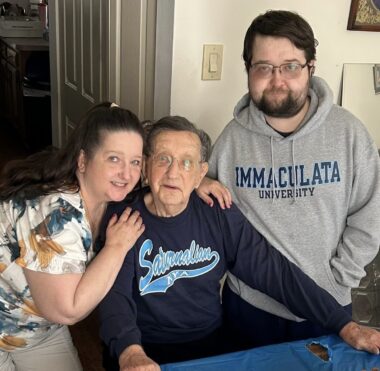
Richard Cyzewski, center, celebrates his 95th birthday with his daughter, Colleen Steele, and grandson, Cullen Steele, on Aug. 15, 2025. (Courtesy of Colleen Steele)
Write to someone you miss
Are you missing someone? Perhaps someone who has passed away? Try writing them a letter. You can send it like a prayer. Imagine your eyes are theirs as you read over what you have written. Listen to your heart and hear how you believe they would respond.
When I learned about National Letter to an Elder Day, I immediately thought of my dad, Richard Cyzewski, who passed away at age 95 on New Year’s Eve 2025.
I have many cards and notes he sent me over the years, and since his passing, I have found a treasure trove of the ones I sent him. This is another good reason to put pen to paper and write to the people we care about, because those memories will someday be more precious than any email or text message. It was once in the writer’s hands, written in their unique script, and penned in a way of speaking that no artificial intelligence has altered.
I will write to my dad on the 26th, a prayer just between him and me, but here is an example that he would approve of me sharing if, in any way, it might help others.
My son Cullen, 26, was diagnosed with PH in 2008, and in 2014, he received a heart and double-lung transplant. This letter focuses on my dad’s influence in helping me be the advocate and caregiver Cullen needed.
My letter to my dad
Dear Dad,
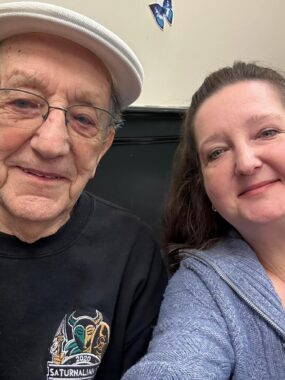
Colleen Steele and her dad, Richard Cyzewski, are all smiles while spending a day together. (Courtesy of Colleen Steele)
Thank you for instilling in me at a young age the importance of listening to my intuition. If it weren’t for that gift, it might have taken longer for Cullen to be diagnosed with PH.
You always led by example, and by watching you handle difficult situations, I remained calm, focused, and asked tough questions throughout Cullen’s PH journey and transplant.
I listened to your words of wisdom: that big decisions should be based not solely on others’ advice, but also on my own research and intuition.
I kept my sanity and helped my family keep theirs by finding ways to enjoy life, smile, and laugh, despite the PH cloud hovering over us. Finding a light in the dark is yet another thing I learned from you.
I still struggle with your favorite motto, “Everything happens for a reason,” but I do try to look back on bad times, not with bitterness, but with acceptance that it was part of my life and important to include when I share my past with others. This mindset is why I am a PH News columnist and forums moderator.
I’m still listening and learning from you, Dad!
Love,
Little One (aka Colleen)
Note: Pulmonary Hypertension News is strictly a news and information website about the disease. It does not provide medical advice, diagnosis, or treatment. This content is not intended to be a substitute for professional medical advice, diagnosis, or treatment. Always seek the advice of your physician or other qualified health provider with any questions you may have regarding a medical condition. Never disregard professional medical advice or delay in seeking it because of something you have read on this website. The opinions expressed in this column are not those of Pulmonary Hypertension News or its parent company, Bionews, and are intended to spark discussion about issues pertaining to pulmonary hypertension.


Leave a comment
Fill in the required fields to post. Your email address will not be published.